

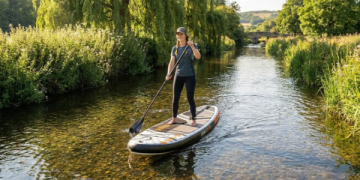


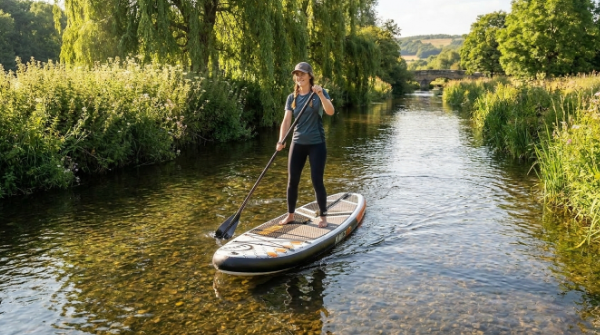
Stand-up paddleboarding has quietly become one of Britain’s favourite outdoor pursuits. From the flatwater canals of Birmingham to the wild sea lochs of the Scottish Highlands, SUP fits almost every landscape the UK has to offer — and the barrier to entry has never been lower.
A big part of that accessibility comes down to the modern inflatable board. Today’s inflatable paddle boards uk pack into a backpack, survive a car boot, and launch from a gravel bank — which means the majority of British waterways that were impractical for rigid board owners are now completely accessible. If you’ve been thinking about getting started, this guide covers everything you need to know before your first session on the water.
Overview & Quick Summary
What is SUP? Stand-up paddleboarding involves standing on a buoyant board and using a single-bladed paddle to move through the water. It’s low-impact, accessible at almost any fitness level, and works on rivers, lakes, canals, and coastal water.
Why the UK? Britain’s diverse waterways — from tidal estuaries to sheltered inland lakes — make it one of the best countries in the world for recreational paddling year-round.
Best board for beginners: A wide, stable all-round board of at least 10’6″ in length and 32″ in width. For most UK riders, an inflatable design is the practical first choice.
Essential kit: Board, paddle, leash, buoyancy aid, and appropriate clothing for the water temperature.
Licence requirements: Many UK rivers require a Paddle UK waterways licence. Annual membership costs under £60 and covers the majority of navigable inland waterways.
Why Paddleboarding Has Taken Off in the UK
A decade ago, SUP was a niche import from surf culture — something you might try on holiday in Hawaii or Portugal. Today it’s mainstream. The reasons are practical as much as they are cultural.
The UK’s paddling infrastructure has matured rapidly. Paddle UK now oversees thousands of clubs and access points nationwide. Local hire companies operate on almost every major lake and river. The sport has also benefited enormously from a wider choice of boards, entry-level coaching, and a growing online community sharing routes, conditions, and advice.
There’s also the mental health dimension. Research consistently links time on open water with reduced stress and improved mood. For urban paddlers especially, a session on a local river or reservoir has become a genuine weekly ritual.
Choosing Your First Board
The board decision is where most beginners get overwhelmed. A quick framework makes it manageable.
Shape & Length
All-round boards between 10′ and 11′ are the standard starting point for recreational UK paddling. They perform adequately on flatwater, handle light chop, and track well enough for longer sessions. Touring boards (11’6″ and above) are better for distance paddling but harder to manoeuvre in tight river sections.
Width & Stability
Beginners should prioritise width over everything else. A board narrower than 30 inches will feel unstable on moving water until your balance adapts — and that takes time. Starting on a 32–34″ wide board dramatically reduces the frustration of repeated falls and lets you build confidence faster.
Volume & Weight Capacity
Check the board’s stated weight capacity and compare it to your body weight plus the kit you plan to carry. For most adults with a dry bag and basic gear, a board rated to 120–150 kg is appropriate.
Inflatable vs Hard Board
For the vast majority of UK beginners, an inflatable is the right first board. They cope well with the rocky riverbeds, irregular launch conditions, and unpredictable British weather common across the country — and the storage and transport advantages for most riders are decisive. Hard boards have genuine advantages for racing and advanced surf SUP, but those benefits only become meaningful once your technique is developed enough to notice them.
Essential Kit Before You Launch
The Paddle
A correctly sized paddle should reach roughly your wrist when you raise your arm straight above your head. Most beginners start with an adjustable aluminium paddle, which covers a range of heights and disciplines. Carbon paddles are lighter and more efficient but significantly more expensive — a worthwhile upgrade once you know you’re committed to the sport.
The Leash
A leash connects you to your board and is non-negotiable. On a river or in surf, a board that gets away from you becomes a hazard to other water users. For flatwater and slow rivers, an ankle leash is standard. For moving water and white water, switch to a quick-release waist belt — ankle leashes are genuinely dangerous in fast-flowing rivers where the board can pin you underwater.
Buoyancy Aid
In the UK, the RNLI and Paddle UK both recommend wearing a buoyancy aid (not a life jacket — the two are different) for all recreational paddling. A well-fitted SUP-specific buoyancy aid allows full arm movement for paddling without restriction.
Clothing
Water temperature in the UK sits between 6°C and 18°C for most of the year, even when the air is warm. Dress for immersion, not for the air. In spring and autumn, a 3mm wetsuit is appropriate. In winter, a drysuit is worth the investment if you’re paddling regularly. In peak summer, a rash vest and board shorts are fine on sheltered flatwater — but always have a warm layer accessible.
Best UK Waterways for Beginner Paddlers
Britain’s geographic variety means you’re rarely more than an hour from something worth paddling. Here are strong starting points across different regions.
The Norfolk Broads remain the gold standard for beginner flatwater paddling in England. Wide, calm channels, abundant wildlife, and a well-developed network of access points make it forgiving and visually rewarding from session one.
Derwentwater in the Lake District offers clear, sheltered water surrounded by fells. Arrive early on weekends to avoid boat traffic. The western shore provides a straightforward circuit for a first open-water session.
The River Wye between Hay-on-Wye and Monmouth is one of the most popular touring rivers in Wales. The gradient is gentle, the scenery is exceptional, and there are multiple egress points if you want to cut a session short.
Loch Lomond gives Scottish paddlers access to enormous stretches of calm inland water within easy reach of Glasgow. Stick to the southern end initially — the northern loch can produce significant wind chop without warning.
The Thames between Richmond and Twickenham is the best urban paddling corridor in the country. Good access, cafés within easy reach, and enough boat traffic to teach you early about reading water and right of way.
Your First Session: What to Expect
Before You Leave Home
Check the weather forecast and, crucially, the wind forecast separately. Wind of 15 mph or above makes flatwater paddling significantly harder for beginners and can push you off course faster than you expect. A calm morning session is worth waking up early for.
Confirm whether your chosen waterway requires a Paddle UK licence. Tidal coastal water requires no licence. Many rivers do. The Paddle UK website has a full map of licensed waterways.
Getting On the Board
Start in shallow, calm water. Place the board flat, kneel first, and feel the stability before standing. When you stand, keep your feet parallel, hip-width apart, centred over the board’s midpoint — not at the tail. Keep your knees soft, your gaze forward (not down at your feet), and your core engaged.
Paddling Technique
Most beginners instinctively paddle like a canoe, blade angled toward them. The correct technique is the opposite — the blade angled away, with the shaft held vertically. Plant the blade fully in the water ahead of you, pull through to your feet, and exit cleanly. This generates forward drive without the inefficient splashing that wears out your arms within 20 minutes.
Falls
You will fall. Everyone falls. The board floats, the leash keeps it attached, and you climb back on from the tail. There is no graceful way to do this and it does not matter. Falling in shallow water is far less comfortable than deep water — the board springs away and your knees find the riverbed. Aim for depth when you can.
Frequently Asked Questions
Do I need a licence to paddleboard in the UK? It depends on the waterway. Tidal sea, coastal, and some navigable rivers are free to access. Many inland rivers require a Paddle UK licence (under £60/year) or a local waterway permit. Always check before launching on an unfamiliar river.
What’s the best time of year to start paddleboarding in the UK? May through September offers the most reliable combination of air and water temperatures. That said, paddleboarding is a year-round activity for those who dress appropriately — winter sessions on a quiet river or loch are genuinely peaceful and far less crowded.
How long does it take to learn to paddleboard? Most people are standing and paddling in a straight line within 30 minutes of their first session. Confident open-water paddling typically comes after three to five sessions. Advanced skills like surfing or white water SUP take considerably longer and are a different discipline entirely.
Can I paddleboard alone? Yes, but take precautions. Tell someone where you’re going and when you expect to return. Carry your phone in a waterproof pouch. Stick to familiar, sheltered waterways when paddling solo. Many clubs offer group sessions which are worth joining early — the local knowledge alone pays off.
How much does a decent beginner SUP cost in the UK? A reliable all-round inflatable package (board, paddle, leash, pump, bag) starts around £300–£400 for a quality entry-level setup. Boards at this price point from established brands will last years with basic care. Avoid very cheap boards below £150 — the drop-stitch construction and valve quality are typically poor and won’t hold pressure consistently over time.

