






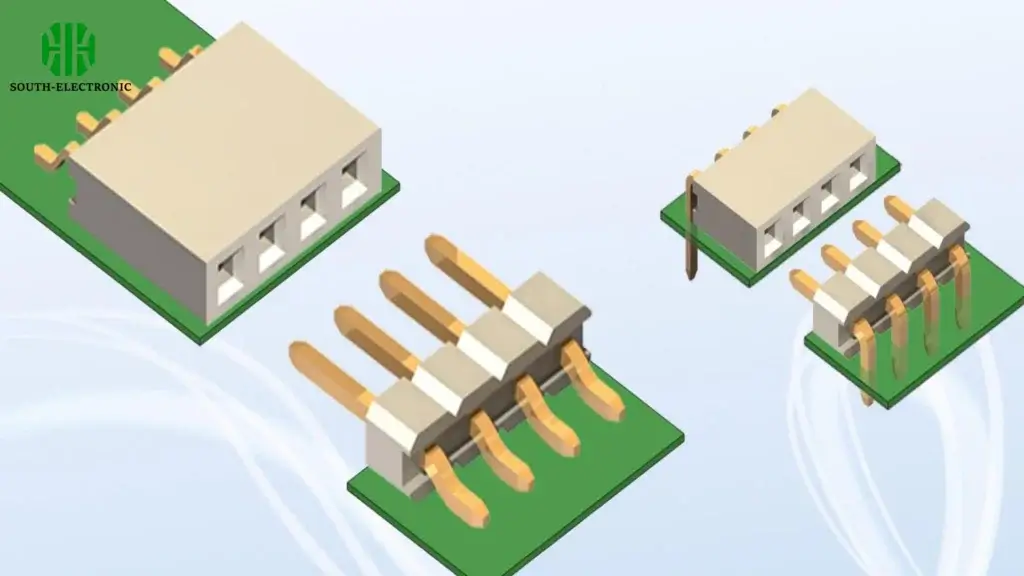
Connectors play a fundamental role in modern electronics. You might use these components when designing industrial equipment, consumer devices, or automotive systems. If you’re overseeing such projects, you should already know the importance of selecting the right type of connector for the given application, given the impact on reliability, manufacturability, and cost.
Across the sphere of electronics design and manufacturing, the choice of interconnect is no less critical than the selection of the processor and power supply.
This brings us to two of the most common interconnect categories that you are likely to find yourself picking between as an engineer or developer: board-to-board connectors or wire-to-board connectors. These are often referred to as “BTB” and “WTB” connectors respectively.
It might seem at first that these two forms of connector are interchangeable. In truth, however, BTB and WTB connectors differ significantly in their structural and functional purposes, so they are not directly interchangeable in most designs.
In this guide, then, we’ll look at those key differences, as well as the advantages and ideal use cases for each option.
An Introduction to Board-To-Board (BTB) Connectors
BTB connectors are designed to enable the direct linking together of two printed circuit boards (PCBs), without intermediary cables being needed. This makes such connectors the go-to solution for the creation of high-density, compact devices.
The way board-to-board connectors work is that one half of the connector (usually with pins) is mounted on one PCB; meanwhile, the receptacle is mounted on the other. The pressing-together of the boards causes them to “mate”, thereby completing the circuit.
Common configurations for BTB connectors include:
- Mezzanine, which involves boards being stacked parallel to one another
- Orthogonal or mother-to-daughter, whereby boards are connected at an angle of 90 degrees
- Coplanar, which is when boards are joined side-by-side on the same plane.
Board-to-board connectors are best for: applications where the available space is limited and signal integrity is of the utmost importance. This encompasses the likes of smartphones, laptops, and high-speed servers.
An Introduction to Wire-To-Board (WTB) Connectors
WTB connectors use a group of discrete wires, or a cable harness, to establish a link between a PCB and external components. Typical examples of the latter include sensors, batteries, or displays. As a result, signals or power can travel between separate components.
The way wire-to-board connectors work is that a header is soldered onto the PCB, which in turn, mates with a housing containing crimped or terminated wires.
Across many WTB systems, a locking mechanism is incorporated. Whether this feature takes the form of friction or positive locks, it can be vital for keeping the connection secure under vibration.
Wire-to-board connectors are best for: systems that necessitate flexibility in routing, frequent maintenance, or connections to external peripherals. Common applications for WTB connectors therefore encompass (but are not limited to) automotive wiring systems, household appliances, industrial machinery, and power supply units.
So, How Can You Decide Between WTB And BTB Connectors for Your Project?
As you have probably ascertained from reading the above, there is no “one-size-fits-all” connector for every possible situation and circuit.
You will therefore need to consider the particular aspects of your project alongside the respective pros and cons of board-to-board versus wire-to-board connectors. The right choice will come down to how your given product is built, used, and maintained.
As a general rule, you will likely opt for a BTB connector if:
- You require a compact, integrated design
- Your PCBs are fixed in position
- Your project involves high-speed or high-frequency signals
- You’re looking to minimise wiring complexity
On the other hand, in the event of the below being true, you might look towards a WTB connector instead:
- There is a need for components to be physically separated
- The system requires flexibility or movement
- You expect maintenance or field servicing
- You’re dealing with higher power delivery
Are you designing an entirely new system? In that case, it can be a wise course of action to prototype both approaches at an early stage. This will likely save you from having to consider changing to another connector type later in the development cycle, which can be much harder to do than a well-informed judgement call from the start.

