





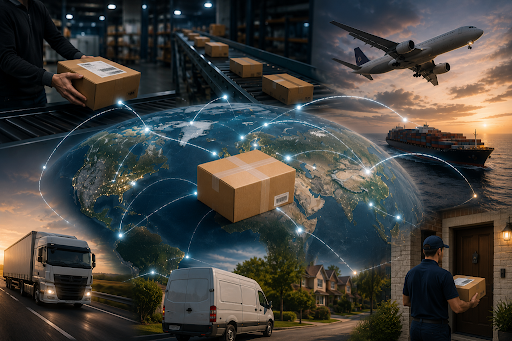
Have you ever sent a gift across the country and felt like it vanished into a black hole? In reality, that little box is having quite an adventure. It rides conveyor belts, catches overnight truck rides, hops on airplanes and sometimes even changes hands between different delivery companies. Here’s a peek behind the scenes of that trip – and how to follow along without losing your mind.
It all starts at the post office
Most journeys begin at a local post office. You hand over your parcel, the clerk slaps on a barcode and – ding! – its digital passport is created. That code will be scanned every time your package hits a new checkpoint, and each scan is what you see on a tracking page.
From the post office, packages head to a sorting center, where machines read addresses and shuffle boxes onto the right conveyor belts. Think of it like an airport security line for parcels. Next come regional hubs – giant warehouses that gather parcels from lots of towns and load them onto long‑haul trucks or planes. Finally, the parcel arrives at a post office near the recipient and gets loaded onto a local carrier’s route.
When it’s FedEx or another courier
Private couriers such as FedEx run a “hub and spoke” network. Picture the wheel of a bicycle: a central hub with spokes reaching out to smaller stations. FedEx moves around ten million packages a day through more than 600 hubs and local stations. A driver picks up your parcel, drops it at the nearest station, and from there it goes to a big hub where it’s sorted by destination. It then travels to another hub closer to the destination and finally to a local station, where a driver delivers it to your door.
Crossing borders and switching partners
When a package leaves the country, things get more complicated. Carriers like DHL use a network of international gateways and airports. Your parcel is bundled with hundreds of others, loaded onto an aircraft, and flown to a hub overseas. Tracking updates like “Arrived at sort facility” or “Transfer through gateway” mark these hand‑offs. Once the parcel clears customs, many couriers hand it over to the destination country’s postal service or a local courier for the last mile. That’s why you might see a status like “Handed over to postal service” before it reaches you.
Why does tracking look different from one carrier to another?
Each company scans parcels at different points in their journey and uses different language to describe those scans. Some postal services update every time a package is sorted; others only scan when it changes trucks. That’s why the tracking log sometimes goes quiet for a day or two – your parcel is still moving, but no one has scanned it yet. Weather or customs can also slow things down.
Don’t panic: follow these easy tips
Waiting can be nerve‑racking, but there are ways to make it less stressful:
- Check the barcode number carefully. A single wrong digit can make you think your parcel has disappeared. The tracking number is the key to seeing updates.
- Learn the language. Statuses like “Out for delivery,” “Departed facility,” or “Handed over to postal service” tell you where your package is. If it says “Transfer through gateway,” it’s probably switching carriers or countries.
- Use a one‑stop tracking page. Instead of bouncing between websites for different couriers, plug your number into an all‑in‑one tracker. You can visit USPS shipment tracking on TrackingPackage to see updates from multiple carriers in one place.
- Turn on alerts. Many tracking tools will send an email or text whenever your package moves. That way you’ll know as soon as it clears customs or arrives at your local post office.
- Be patient. Surveys show that two‑thirds of people check their deliveries every day and a quarter refresh the page multiple times. But the journey takes time – especially across oceans or through storms.
Stories from the road
To make this more fun, imagine a few real‑life scenarios:
- A college student orders a new laptop. It leaves a fulfillment center in California with a private courier, rides a night truck to a hub in Phoenix, hops onto a plane to New York, then travels on to the UK. Once in London, the parcel is cleared by customs and handed to the Royal Mail for final delivery. The student watches the tracking log light up each time the box lands in a new city.
- A small business in Ohio ships handmade crafts to customers worldwide. One package to France travels with USPS through network distribution centers, transfers to a hub at the airport, flies to Paris with an international courier, and then rides with France’s postal service to a farm in the countryside. Thanks to tracking alerts, the seller knows it arrived just in time for a birthday.
- During the holidays, a family mails care packages to relatives in Alaska. The boxes move from their local post office to a regional center, board a cargo flight to Anchorage and then load onto small planes for remote villages. Bad weather grounds the planes for a day, but the tracking status shows that the packages are safe at the hub. Once the skies clear, the parcels make the final leg by snowmobile – and everyone breathes a sigh of relief.
These stories show that parcels are not just sitting still; they’re constantly moving through networks designed to get them to you as quickly as possible.
Keeping track, staying calm
Knowing what happens behind the scenes can turn waiting into a kind of game. Watch for the different statuses, cheer when your package “arrives at sort facility,” and don’t worry if it goes silent for a while. If there’s a long gap, check the most recent scan and give the carrier a day or two to catch up. And if you need an easy way to see the whole journey at a glance, the USPS shipment tracking portal on TrackingPackage can help you follow your parcel across post offices, hubs, airplanes and local couriers without switching sites.
With a bit of patience and the right tools, you can turn package tracking from a stress‑inducing mystery into a lighthearted look at your parcel’s worldwide road trip.

