






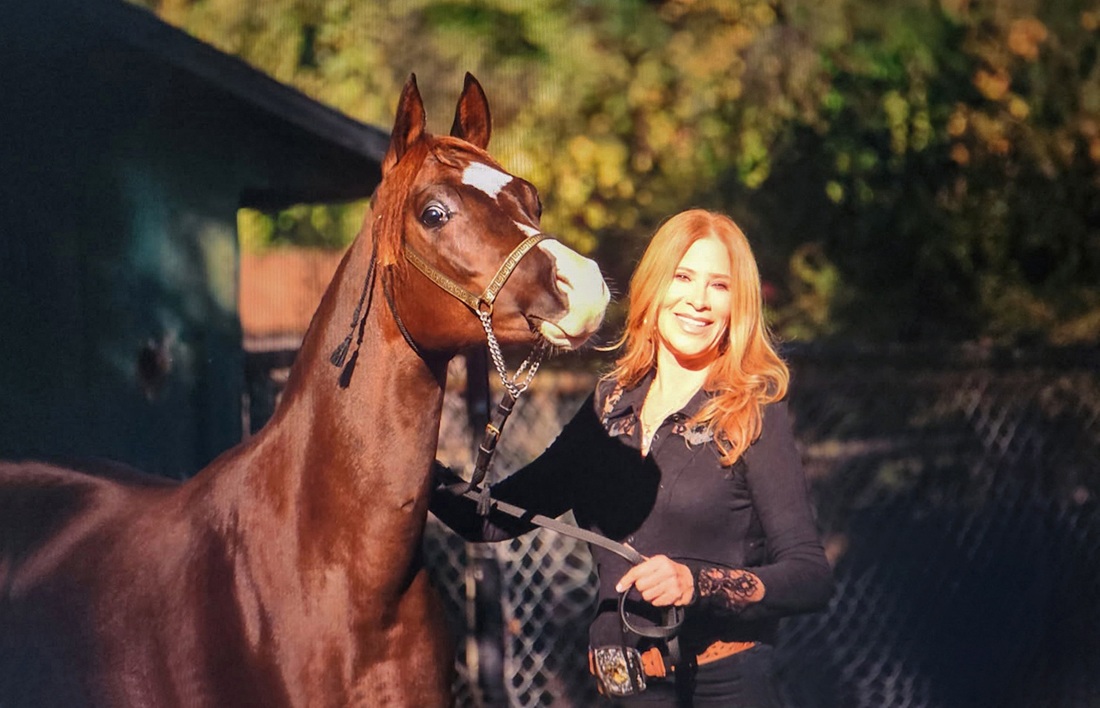
On her California estate, nestled among the vineyards of wine country, former radio personality and philanthropist Ann Lesley Smith has discovered something that many people spend a lifetime searching for: peace and a sense of purpose.
Smith’s story is far from conventional, but each twist and turn in her life has led her to a place where she can give back in a big way. Her main inspiration comes from one of the least likely places: the empathetic personality of an Arabian horse.
Today, on a property that functions as both her own place of renewal and a sanctuary for others, Smith is helping people slow down and rediscover their purpose, just as she has rediscovered her own.
The Arabian stallion at the center of it all
After the death of her husband, musician and mogul Chester Smith, Ann Lesley surrounded herself with what made her happy — her prized collection of Arabian horses. One horse in particular has been especially transformative in Smith’s life. Her stallion, Amir Fadjur Salaam, has been a beacon of light in some dark times for Smith, and his example has led her to some big ideas, from how to help others to how to inspire tomorrow’s technology.
“I have learned that peace is not passive, and Amir has been my best teacher,” says Smith.
Arabian horses are known for their intuitive nature and intelligence. Bred over thousands of years to have an almost human-like level of empathy, the breed has long been a favorite of equestrians seeking more than just a beast of burden. Amir is a direct descendant of The Fabulous Fadjur, one of the most celebrated Arabian horses in recent history.
“He carries the same personality traits as Fadjur,” explains Smith. “He could almost read your mind and know what you were thinking, and Amir has that same human-like ability to empathize.”
Feeling connected to something larger than herself, Smith began brainstorming ways Amir could inspire others. It’s what led her to open up her estate to people who may need a rest, an escape from burnout, or just a chance to revel in the liberty of the free-roaming Arabians.
“You can feel something change in people when they see the Arabians running free among the hills of the estate. People are not accustomed to that amount of freedom. It moves them,” says Smith.
Amir’s message in modern life
Smith also believes that Amir’s level of empathy, kindness, and intelligence can be a workbench for a new movement toward peace, one that harkens back to the original intention of the Arabian horse lineage.
“Arabians were often given as gifts and symbolized goodwill,” says Smith. In a world that is increasingly divided, Smith believes the Arabian horse could again be an ambassador for peace.
In addition to Amir serving as a symbol of a more peaceful existence, Smith believes the Arabian horse’s background could inform modern technology. The idea came to her after seeing the robotic accomplishments of Boston Dynamics’ robot, Atlas. She felt that, as incredible as the robot was, with all of its programming to help human beings in a day-to-day capacity, it still could not empathize in a human-like manner.
“That’s where I feel a horse like Amir could be a workbench for developers,” explains Smith. “Over 4,500 years, the Bedouin tribes programmed these horses to have empathy and intelligence, much in the same way today’s AI developers would like to program the robots created to help humans.”
From bringing about a more peaceful accord between countries to helping influence the next generation of AI, Smith has a deep, abiding faith that the unique personality of the Arabian horse could be a vessel for change.
Peace and serenity practiced
Smith acknowledges that having Amir in her life has changed it for the better. She has found a peace that she was unsure was possible just a few years ago, and she is anxious to share what she has discovered with the world.
The message that Smith hopes to share is both timely and timeless, influenced by thousands of years of breeding tradition and a modern approach to communication and connection. As Smith sees it, a horse can be what leads us all down the path of more clarity, more understanding, and a more peaceful existence.
“Peace isn’t so out of reach as we may believe,” says Smith. “I think if we take time to study the heritage and example of Arabian horses like Amir, we can find a better way to a more peaceful existence.”

