




For years, the TV stand was a supporting actor. It held the television, maybe a cable box, and stayed visually quiet. It was measured against the screen it carried and little else.
That equation has shifted.
In many contemporary homes—especially open-plan apartments and multipurpose living rooms—the television console now absorbs responsibilities that once belonged to separate cabinets or media rooms. It manages devices, conceals wiring, stabilizes oversized screens, and increasingly acts as one of the room’s primary storage pieces. In this context, the mid century TV stand has proven particularly resilient.
The TV Stand Has Outgrown Its Original Role
Living rooms today accommodate more technology than they once did. Streaming boxes, gaming consoles, routers, speakers, remotes, and charging hubs all compete for space. At the same time, television screens have grown steadily larger. What once felt proportionate beneath a 50-inch screen can appear undersized beneath a 75- or 85-inch display.
As screens expand, their visual weight increases. A narrow console under a wide television can create a top-heavy effect, compressing the wall composition. The response has not been decorative—it has been structural. Furniture has extended horizontally to redistribute weight and restore balance.
Meanwhile, storage pressure has migrated into the living room. Fewer built-in cabinets, fewer enclosed media rooms, and more open layouts mean primary furniture pieces must do more. Instead of functioning purely as a surface, the TV stand increasingly acts as concealed storage for electronics, accessories, and small household items.
The shift is subtle but significant: the TV stand is no longer just a media platform. It is becoming an organizing anchor.
The Structural Advantage of the Mid Century TV Stand
Mid-century TV stands tend to share consistent characteristics: a low, horizontal silhouette; tapered legs that lift the cabinet from the floor; warm natural wood finishes; and restrained detailing. These features influence how the piece performs in a space.
Low and Horizontal
Wider-than-tall proportions distribute visual weight across the wall rather than stacking it vertically. When placed beneath a large screen, this horizontal emphasis can help stabilize the composition. Instead of the television appearing dominant and isolated, the console extends the visual line and grounds it.
Lifted on Tapered Legs
Rather than resting on a heavy plinth, most mid-century designs are elevated on slim, often slightly splayed legs. The visible space beneath the cabinet introduces negative space, allowing light to pass through. In smaller living rooms, this lift reduces visual density and prevents the piece from feeling bulky.
Material Warmth
Natural woods—particularly walnut, teak, or oak—are central to the mid-century vocabulary. Warm mid-tone finishes and visible grain soften the stark contrast of a black screen mounted above. The wood becomes a counterbalance to the technology it supports.
Clean Storage
Flat-front doors, minimal hardware, and a mix of closed cabinetry with selective open shelving maintain visual control. Cable cutouts and adjustable shelves accommodate routers and consoles without exposing wiring. Storage remains integrated rather than appended.
These structural qualities help explain why the mid-century format continues to integrate easily into contemporary interiors. Its proportions ground large screens, its lifted base lightens the footprint, and its storage approach keeps visual noise contained.
When Scale and Storage Converge
As television sizes have increased, console length has expanded in response. A longer format—such as a 79-inch mid century TV stand—extends the horizontal line beneath the screen and redistributes visual weight more evenly across the wall.
But length does more than correct proportion. It increases storage capacity.
A wider footprint allows multiple cabinets to coexist with carefully placed open compartments. Closed sections conceal routers, gaming systems, and cables; open areas allow ventilation for active devices. In open-plan living rooms, where the media wall is visible from multiple angles, this separation between display and concealment becomes more important.
Concealed storage has gradually shifted from secondary feature to primary design consideration. Rather than relying on fully open shelving, many contemporary interpretations favor flat-front doors or partially transparent panels—such as arched glass—that soften the façade while masking clutter. Integrated cable management further supports the evolving mix of devices.
In this context, added length is not excess. It is an adaptation. The increase in size responds to both visual proportion and storage demand.
From Object to Infrastructure
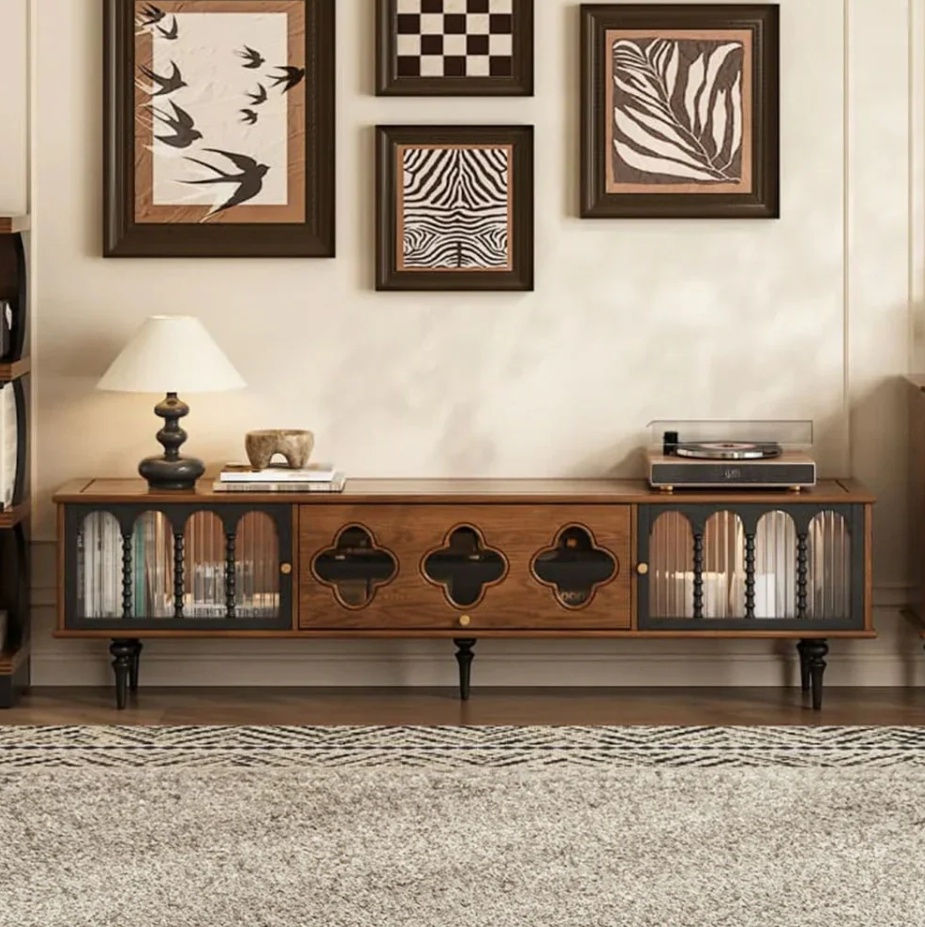
Consider a long walnut console with arched glass doors in a 79-inch format. The extended base grounds a large screen, while interior compartments absorb the practical realities of modern technology.
Walnut tones introduce warmth against neutral walls. Glass panels maintain lightness, allowing the cabinet face to feel less dense while still concealing contents. Hidden cutouts manage wiring without disrupting the clean exterior lines.
In this configuration, the console no longer behaves as decorative furniture alone. It functions as infrastructure—supporting the television, organizing devices, redistributing visual weight, and shaping how the wall reads as a whole.
The change is not dramatic in appearance, but it is structural in impact.
Living Room Furniture as an Integrated System
A TV stand does not exist in isolation. It interacts with sofas, coffee tables, rugs, and lighting. When storage consolidates into one grounded, elongated piece, other elements can simplify. Coffee tables can remain lighter and less compartmentalized. Additional side cabinets may no longer be necessary. The room stabilizes around a single horizontal anchor.
In smaller apartments especially, every piece must justify its footprint. Furniture that combines surface area, concealed storage, and proportion reduces redundancy. The console becomes part of a broader living room furniture strategy rather than a standalone accessory.
This integration is where the shift becomes most visible. The TV stand absorbs complexity so the rest of the room can remain calm.
From Media Platform to Storage Architecture
The mid-century TV stand has not reinvented itself overnight. Instead, the conditions around it have changed: larger screens, fewer built-ins, open layouts, and increased reliance on concealed organization.
Its low stance, lifted base, warm wood tones, and integrated cabinetry happen to respond well to these pressures. What once functioned primarily as a surface now operates as a structural anchor for the room—organizing equipment, balancing scale, and quietly shaping spatial rhythm.
The evolution is gradual rather than dramatic. Yet it reflects a broader adjustment in how living rooms function today.
The mid century TV stand is no longer simply a console beneath a screen. In many homes, it has become part of the architecture of storage itself.

