







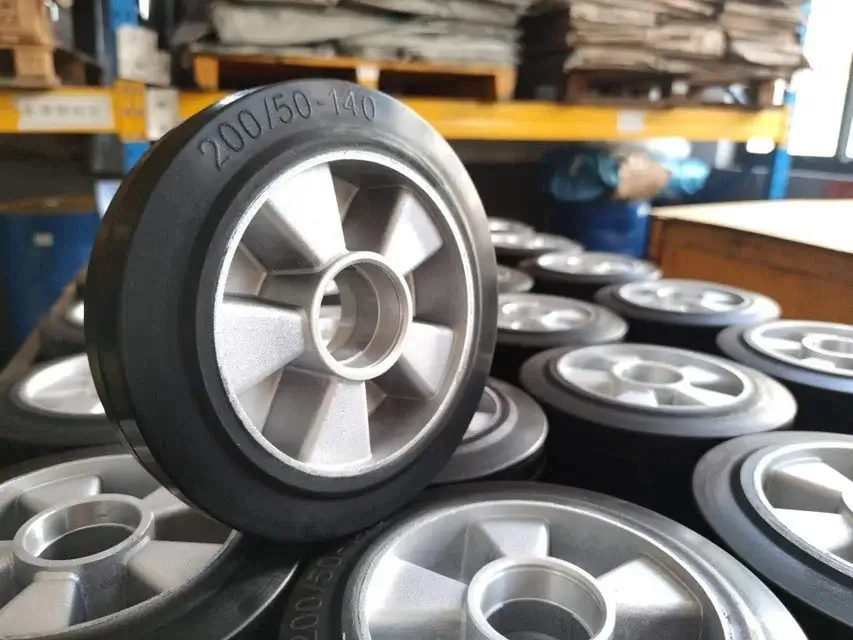
In industrial environments, wheel selection is rarely about preference. It is driven by how equipment behaves under load, how often it moves, and how much tolerance there is for failure. While pneumatic and polyurethane wheels have their place, there are many situations where their limitations become operational risks rather than advantages.
This distinction is easiest to see in environments where Solid Rubber Wheel Industrial Applications overview is relevant as a reference point for understanding how wheel behavior affects safety, uptime, and maintenance planning. The use cases below highlight where solid rubber wheels consistently outperform common alternatives.
Manufacturing Floors with Continuous Load Cycles
Manufacturing facilities often rely on carts, fixtures, and mobile stations that remain under load for extended periods. Equipment may move only intermittently, spending most of the shift stationary.
Solid rubber wheels perform better in these settings because:
- They resist deformation during prolonged static loading
- Load distribution remains stable between movement cycles
- Wheel performance does not change based on air pressure or temperature
In solid rubber wheel industrial applications, this stability reduces frame stress and helps equipment age more evenly over time.
Warehousing and Distribution with Mixed Floor Conditions
Warehouses rarely have uniform flooring. Expansion joints, patched concrete, ramps, and transition zones introduce variability that can affect wheel performance.
Solid rubber wheels tend to outperform alternatives because:
- Traction remains consistent across uneven surfaces
- There is less bounce when crossing seams or floor transitions
- Directional control is easier to maintain under load
For operations that rely on repeated routes and predictable movement, solid rubber wheel industrial applications support smoother material flow than air-filled options.
Facilities Prioritizing Low Maintenance Over Cushioning
Pneumatic wheels offer shock absorption, but they also introduce maintenance complexity. Leaks, pressure loss, and punctures often become recurring issues in high-use environments.
Solid rubber wheels are preferred when:
- Maintenance resources are limited
- Downtime from minor failures is unacceptable
- Predictable replacement cycles are needed
In solid rubber wheel industrial applications, the ability to plan maintenance instead of reacting to failures is often more valuable than added cushioning.
High-Traffic Industrial Environments
Facilities with shared traffic—operators, carts, and powered equipment moving through the same spaces—require wheels that behave consistently.
Solid rubber wheels support safer operation by:
- Limiting sudden changes in rolling resistance
- Reducing lateral flex during turns
- Maintaining stable movement on inclines and ramps
These characteristics make solid rubber wheel industrial applications well suited to environments where control and predictability matter more than speed.
Closing Perspective
Solid rubber wheels are not a universal solution, but they excel in environments where consistency outweighs adaptability. Their advantages become most visible under continuous load, repeated movement, and imperfect floor conditions.
By understanding where solid rubber wheels outperform pneumatic and polyurethane alternatives, facilities can make more informed decisions that support uptime, safety, and long-term operational stability.

