








Have you ever had this spooky experience? You sleep in bed for 8 hours. But when you look in the mirror the next morning, you see a stranger. Your face is puffy. Your jawline is gone. Your under-eye bags feel as heavy as lead weights.
Welcome to the era of “Cortisol Face.”
A massive 2025 study in Frontiers in Psychiatry proves that scrolling before bed destroys your sleep. Data from over 540,000 people shows that every extra hour of screen time delays your sleep by 13.2 minutes and triples your risk of severe insomnia. This biological storm—caused by the hazards of screen time before bed—traps you in a stressful “tired but wired” cycle. Ultimately, this constant lack of deep rest spikes your stress hormones and directly triggers the severe facial swelling, water retention, and exhausted look we call Cortisol Face.
Do you want to fix trouble sleeping and get your jawline back? You do not need expensive face creams. You need to set strict borders against digital light.
The Biological Hijack: Why Your Phone is a “Sun in Your Pocket”
To understand why your face holds water and your brain stays awake, we must look at how your eyes and hormones connect. The root of the problem lies in special eye cells called Intrinsically Photosensitive Retinal Ganglion Cells (ipRGCs).
Think of your ipRGCs as highly anxious security guards for your brain’s clock. Their only job is to watch for specific light—mostly the bright blue light from the sun or your phone. When they see this light, they radio the brain. They tell it that it is high noon. They do this even if you are lying in the dark at 11:30 PM.
When your phone screen triggers these cells, they send a fast signal to your master body clock (the SCN). The SCN then flips a chemical switch. It forcefully stops your natural melatonin production (the hormone that makes you sleepy and heals your cells). Instead, it tells your body to release cortisol to keep you awake.
The Anatomy of Cortisol Face
When cortisol floods your body at night, you enter a “fight or flight” survival mode. Survival modes break things down in your body.
Water Retention: High cortisol makes your kidneys hold onto salt. This causes severe swelling, especially in your face. It creates the dreaded “moon face.”
Collagen Breakdown: Long-term night cortisol actively destroys the protein fibers that keep your skin tight.
Blood Sugar Spikes: Stress hormones dump sugar into your blood for fast energy. The unused sugar binds to proteins in your skin. This process is called glycation. It ages your skin and makes it look dull.
You must treat evening eye care as a health need, not just an optional habit. This stops the hormone storm at the source and speeds up cortisol face recovery.
The Data Analysis: The Hidden Cost of “Just One More Video”
If we look at the clinical data on the hazards of screen time before bed, we see how fragile our sleep really is. Cortisol face recovery is impossible if we ignore the math of melatonin.A clinical study in the Journal of Clinical Endocrinology & Metabolism (JCEM) reveals the true destructive power of night light. Data shows that exposure to screen light or normal room light before bed severely delays melatonin production in 99% of people. Even worse, it causes your total melatonin levels to drop by over 50% and cuts your body’s healing time by a full 90 minutes.
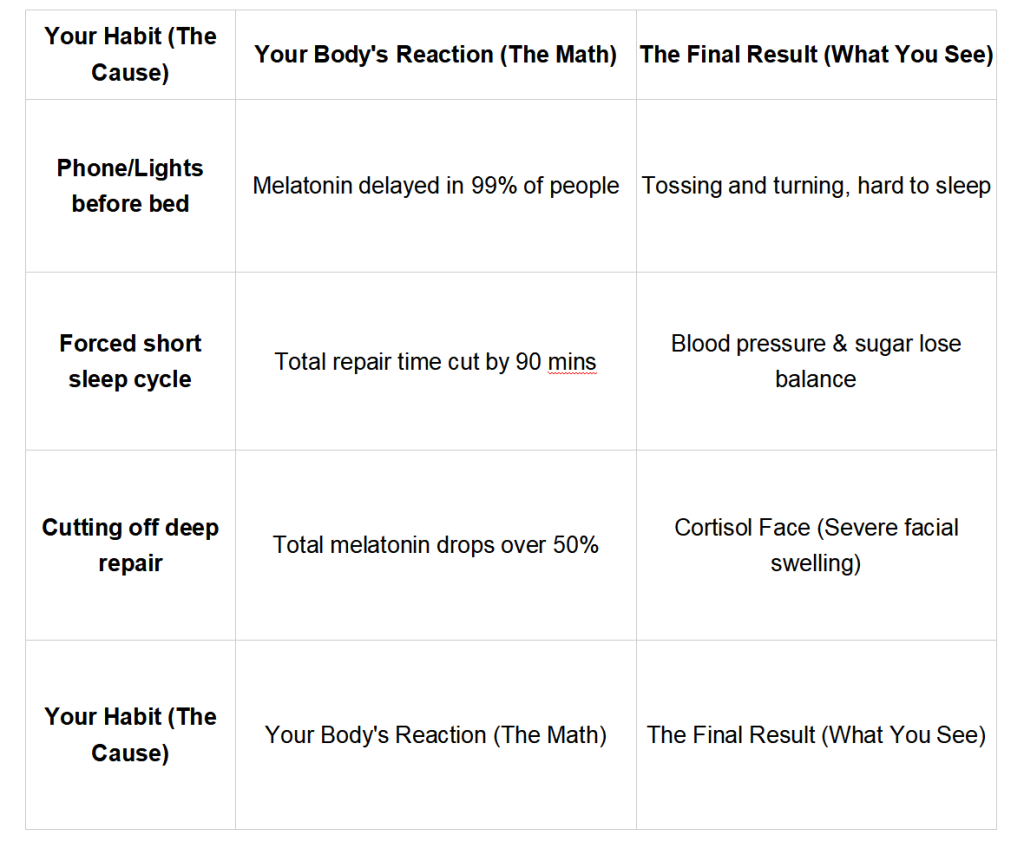
When you delay your cell repair (melatonin) by 90 minutes and add a stress response, your body misses its nightly clean-up. The waste-removal system in your brain fails. Your body cannot drain extra fluid from your face.
To fix trouble sleeping and reverse these physical signs of fatigue, we must create a fake sunset.
The Sleep Protocol: The 1-Hour Cortisol Face Recovery System
Sleep is not an on-off switch. It is a slow descent. You cannot fly a huge commercial airplane and land it safely in 30 seconds. Your brain needs a structured landing plan.
Here is the exact 60-minute guide to optimize your evening eye care, eliminate sleep anxiety, and get deep rest.
Phase 1: The Digital Sunset (60 Minutes Out)
When you are 60 minutes away from your target bedtime, you must block the light. This is when you put on your red sleep glasses.
Think of these red sleep glasses as a giant “Do Not Disturb” sign for your eye’s security guards. By completely blocking all light under 550nm (the blue and green light that stops sleep hormones), you create a dark environment for your brain. Your brain thinks the sun has set. It opens the melatonin floodgates, even if you are still looking at a screen.
Phase 2: Cognitive Offloading (40 Minutes Out)
With your red sleep glasses on, it is time to handle the mental side of high cortisol. Sleep anxiety feeds on the “open loop” effect. These are unfinished tasks, unread emails, and stressful talks playing on repeat in your head.
Grab a real pen and paper. Do a 5-minute “brain dump.” Write down every task for tomorrow and every anxious thought you have right now. By getting these thoughts on paper, you shift your nervous system. You move from the active “doing” state to the passive “resting” state. Your brain stops wasting energy trying to remember things. This drops your cortisol levels even more.
Phase 3: The Thermal Drop (20 Minutes Out)
Light is the main control for your body clock. Temperature is the second control. To trigger the final stage of sleep, your core body heat must drop by about 1 to 2 degrees Fahrenheit.
Take a warm, 5-minute shower. This sounds backward, but warm water brings blood to your skin. When you step out of the shower into a cool, dark room, your body heat escapes fast. Your core temperature drops quickly. This heat drop is a massive biological signal to your body that it is time for deep, healing sleep.
Conclusion: Reclaim Your Biology, Reclaim Your Face
“Cortisol Face” is not a permanent curse. It is just a sign that your body is completely out of sync with nature. By understanding the hazards of screen time before bed and respecting your delicate body clock, you can reverse the puffiness. You can beat sleep anxiety and wake up looking as fresh as you feel.
Do not let your devices control your hormones. Take control of your light environment tonight. You will take control of your life tomorrow.
Citation
- He X, Pan B, Ma N, Li D, Kong W, Liu Q, Liu X, Wang X, Deng X and Yang K (2025) The association of screen time and the risk of sleep outcomes: a systematic review and meta-analysis. Front. Psychiatry 16:1640263. doi: 10.3389/fpsyt.2025.1640263
- Gooley, J. J., Chamberlain, K., Smith, K. A., Khalsa, S. B. S., Rajaratnam, S. M. W., Van Reen, E., Zeitzer, J. M., Czeisler, C. A., & Lockley, S. W. (2011). Exposure to room light before bedtime suppresses melatonin onset and shortens melatonin duration in humans. The Journal of Clinical Endocrinology & Metabolism, 96(3), E463–E472.

